
Nina Chkareuli
SACRIFICIAL RITES
Now I think every person is a story and I am looking for a title for all of them. If I meet you somewhere and you start talking to me I would momentarily imagine that you are a story and I will find a title for you. Goderdzi Chokheli
Dual presentation of the accomplished Georgian artist Rusudan Khizanishvili and well-known Mexican artist Chucho Reyes opens up a unique avenue for intercultural discourse between Georgia and Mexico. Khizanishvili represents the post-Communist generation of Georgian female painters, sharing their difficult path of overcoming generational, hierarchically gendered, and post-colonial trauma while finding presence among the contemporary art landscape.
Jesús Reyes Ferreira, (1880-1977), known as Chucho Reyes, was a self-taught artist, art collector, and stage set designer who, for many decades, stands out in the art history of Mexico for his idiosyncratic language nourished with folk traditions, juxtapositions, and forms. In their own way, both artists are grounded in their sources, geohistorical characteristics, and concerns, but neither one of them is just a passive observer.
Both Khizanishvili and Reyes exemplify their national visual traditions while staying far away from cliches or banal appropriations of the common symbols. This exhibition looks at what themes also unite them, one of them being the concept of a sacrifice, either in a literal or a metaphoric way.Conceptual keys to this visually enriching exhibition full of hidden allusions could be found in diverse sources, including Human Sadness, a 1984 Georgian post-modernist novel by Goderdzi Chokheli, Violence and The Sacred, a 1972 treatise by French poststructuralist René Girard, as well as the concept of horizontal art history first introduced by the Polish art historian Piotr Piotrowski in 2009. Theory of horizontal art history is important here as it brings the visual traditions separated by oceans and mountains into a one communicative and chronological device where artists use individualism to overcome the anxiety of influence artificially created by postcolonial subjugation to the western traditions. The exhibition on view is an example of this approach to art history.
Presented paintings and drawings by Rusudan Khizanishvili, created in 2024-2025, all focus on offerings, albeit of different types. There is not a single tautology or repetition in these rich, textured, expressive representations imbued with personal symbolism and concern for human fate in a post-human world, characteristic of the artist. For Khizanishvili, the concept of sacrifice is the symbol of rebirth, when one thing is lost for the new one to emerge. Sometimes this means sacrificing one’s own fears, traumatic memories, and personal spaces so that the works in return gain presence. For the artist, this process is almost a ritual – a recalibration of personal equilibrium which is transformed into her creative method. The concept of sacrifice, or rather the idea of a surrogate victim, as outlined by René Girard, is a fundamental characteristic of the human and genetic code. Someone in society or a family is paying for the well-being of the rest; in Georgia, it was habitually a role played by women. Observing this process from this historical standpoint is rewarding as our archaic past meets our digital future.
Chucho Reyes also shows us the transformation of his realistic ecosystem into symbols of his own aesthetic. Sacrifice here is fleeting and metaphoric in nature. Poetic flights of fancy on the ephemeral sheets of crêpe paper use architectonic images of angels and joyfully transcended figures that are about to welcome a more joyful reality. Offerings gracefully provided by Khizanishvili are the price we have to pay for it.
Nina Chkareul
Ahora pienso que cada persona es una historia, y busco un título para todas ellas. Si te encuentro en algún lugar y empiezas a hablarme, por un instante imaginaré que eres una historia, y encontraré un título para ti. — Goderdzi Chokheli
La presentación conjunta de la destacada artista georgiana Rusudan Khizanishvili y del reconocido artista mexicano Chucho Reyes abre una vía singular de diálogo intercultural entre Georgia y México. Khizanishvili pertenece a la generación poscomunista de pintoras georgianas que han debido recorrer un arduo camino para superar traumas generacionales, de género y poscoloniales, mientras afirman su presencia dentro del panorama del arte contemporáneo.
Jesús Reyes Ferreira (1880–1977), conocido como Chucho Reyes, fue un artista autodidacta, coleccionista y escenógrafo que durante décadas ocupó un lugar único en la historia del arte mexicano por su lenguaje personal, nutrido de tradiciones populares, yuxtaposiciones y formas.
Ambos artistas están profundamente arraigados en sus fuentes, en sus contextos geohistóricos y en sus inquietudes, pero ninguno de ellos es un observador pasivo. Tanto Khizanishvili como Reyes encarnan las tradiciones visuales de sus países evitando los clichés y las apropiaciones banales de símbolos comunes. Esta exposición explora los temas que los unen, siendo uno de ellos el concepto de sacrificio, entendido tanto en un sentido literal como metafórico.
Las claves conceptuales de esta exposición, visualmente rica y llena de alusiones sutiles, pueden rastrearse en diversas fuentes: Tristeza humana, la novela posmodernista georgiana de 1984 de Goderdzi Chokheli; La violencia y lo sagrado (1972), el tratado del pensador posestructuralista francés René Girard; y la noción de historia del arte horizontal, introducida en 2009 por el historiador polaco Piotr Piotrowski. Esta última teoría resulta especialmente relevante, pues propone una lectura del arte que enlaza tradiciones visuales separadas por océanos y montañas dentro de un mismo dispositivo comunicativo y cronológico, donde los artistas utilizan su individualismo para superar la ansiedad de influencia impuesta por la subordinación poscolonial a las tradiciones occidentales. La exposición es un ejemplo concreto de este enfoque hacia la historia del arte.
Las pinturas y dibujos de Rusudan Khizanishvili, realizados entre 2024 y 2025, giran en torno a distintas formas de ofrenda. No hay tautologías ni repeticiones en estas representaciones ricas, texturizadas y expresivas, impregnadas de simbolismo personal y de una profunda reflexión sobre el destino humano en un mundo poshumano, rasgo característico de la artista. Para Khizanishvili, el sacrificio es un símbolo de renacimiento: algo debe perderse para que algo nuevo surja.
A veces esto implica sacrificar los propios miedos, las memorias traumáticas o los espacios personales, de modo que las obras, a cambio, adquieran presencia. Para la artista, este proceso es casi un ritual: una recalibración del equilibrio interior que se transforma en su método creativo. El concepto de sacrificio —o, más precisamente, la idea de la víctima sustitutiva, según René Girard constituye un rasgo fundamental del código humano y genético. En la sociedad o en la familia, siempre hay alguien que paga por el bienestar de los demás; en Georgia, ese papel solía recaer en las mujeres. Observar este proceso desde una perspectiva histórica resulta revelador, pues en él se encuentra nuestro pasado arcaico frente a nuestro futuro digital.
Chucho Reyes también nos muestra la transformación de su ecosistema realista en símbolos de su estética personal. El sacrificio, en su caso, es fugaz y metafórico. Sus vuelos poéticos sobre las efímeras hojas de papel de china construyen imágenes arquitectónicas de ángeles y figuras transfiguradas que parecen a punto de recibir una realidad más luminosa. Las ofrendas que Khizanishvili dispone con gracia son, en cierto modo, el precio que debemos pagar para acceder a ella.
Nina Chkareuli
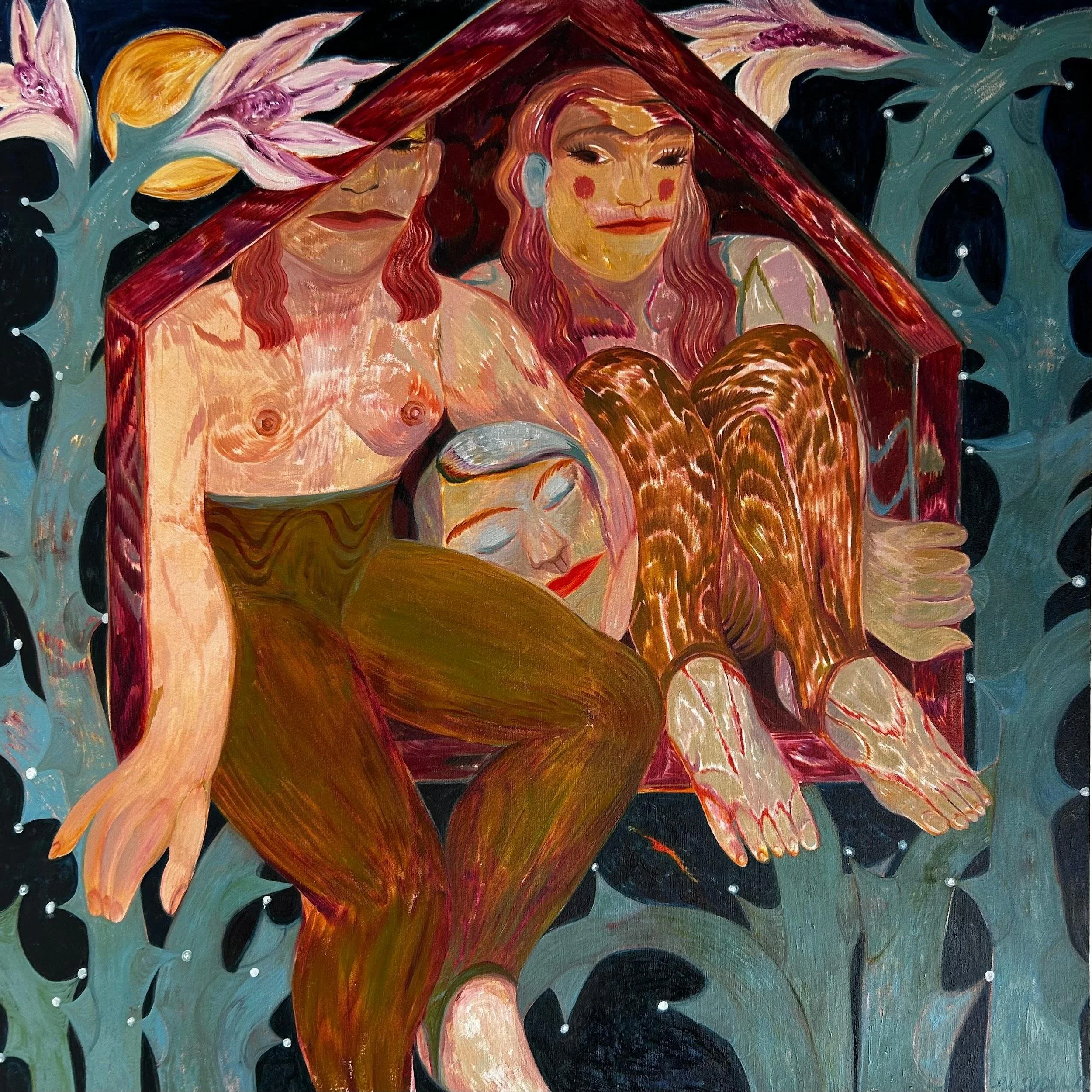
Casa del Árbol I, 2025
Oil on canvas
35.43” x 35.43” in
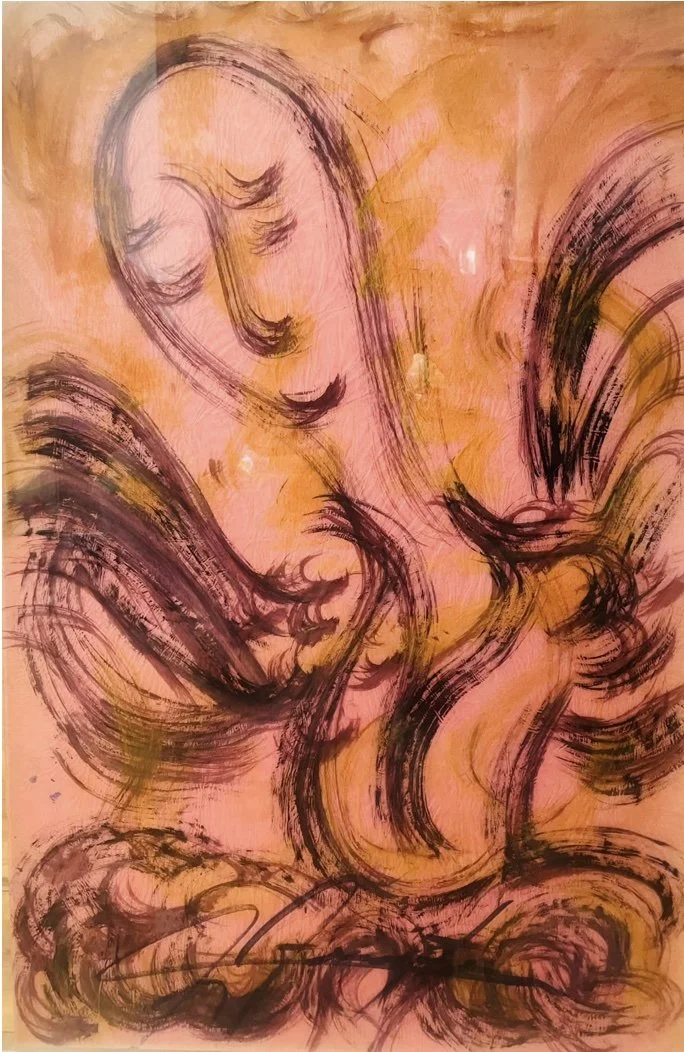
Ángel, 1940 - 1950
Aniline dye on tissue paper
29.52” x 19.48” in