
Bruno Enciso
OBJECT ROMANTIEK
With a gaze captivated by the delicacy of a flower, with a breath that ensures maximum oxygenation in the blood, and without fear of the edge of high contrast: that is the body walking these paths.
Santiago Evans Canales’s painting generously unfolds pictorial spaces where color creates possibility, and possibility colors desires, gestures, and curiosities. Each figure has found its place only after taking a risk, from which it retains a certain volatility. In ceaseless exploration of his own kastanophobia (fear of the color brown), the artist manipulates colors—his own—as much as flesh as light, as truth and reverie. The seriousness with which he modulates the weight and surface of each of his forms never contradicts the gentle charm of the beings who bravely inhabit his paintings—beings animated by the literary pulse of an old tale perpetually on the verge of becoming disconcerting. The moment in his painting does not come from an instrument that cuts through time but from touch, from the brush of two chromatic presences that grant each other’s presence.
This exhibition reimagines the concept of “object permanence,” introduced by the Swiss psychologist Jean Piaget as part of his theory on children’s cognitive development. It is posited that as young children interact with their environment, they eventually learn that objects and people continue to exist even when they are out of sight. In a curious and productive digression, Santiago extends this framework of sensory learning to produce a series of encounters with objects whose consistency cannot be demonstrated without taking into account a sentimental dimension. It is not so much a nostalgic reading of specific objects as it is an actualization of the conditions of possibility for knowledge. In these paintings, objects are “ready” to be apprehended only to the extent that we recognize ourselves as part of an emotional and inevitably dizzying plane. Seemingly simple shapes and colors are imbued with an unnoticed emotional complexity. Language no longer underpins factual truth; here it takes the form of a chuckle and a stumble, or at best, of verse. Its technical function is suspended, but the plastic prevails, just as the proper name softens to highlight the grimace.
The enigma in Santiago’s work is vast and labyrinthine. It draws on the imagination of a child who struck a deal with painting under unknown terms as soon as he had the chance. This deal—a spell?—made him impervious to the photographic and allowed him to retain the warmth of the sun despite the gray rain with which he lived for so long in the old world. There is also the uninterrupted assimilation of paintings by others: technicians, naives, magicians, and madmen. Evans Canales cultivates his references with enthusiasm but also with nonchalance, fully aware of the inexhaustibility of the painterly endeavor. This particular exhibition aims to develop just one of his potentials—the one that challenges the hyper-consistency of the contemporary, harnessing the values of painting to reclaim the childlike gaze, now his own, which has not taken the gaze-truth relationship for granted.
Bruno Enciso
Con la mirada prendada de la delicadeza de una flor, con una respiración que garantice la mayor oxigenación en la sangre y sin miedo al filo del alto contraste: ese es el cuerpo que camina estos senderos. La pintura de Santiago Evans Canales despliega generosamente espacios pictóricos donde el color produce posibilidad y la posibilidad colorea los anhelos, los gestos y las curiosidades. Cada figura ha encontrado su lugar sólo después de haber tomado un riesgo, del que conserva cierta volatilidad.
En incesante exploración de su propia kastanophobia (miedo hacia el color café), el artista manipula los colores, los suyos, lo mismo como carne que como luz, como verdad y ensoñación. La seriedad con la que modula el peso y superficie de cada una de sus formas nunca entra en contradicción con el amable encanto de los seres que habitan valientemente sus cuadros, seres animados por el pulso literario de un viejo cuento en permanente amenaza de volverse desconcertante. El instante en su pintura no viene de un instrumento que corta el tiempo sino del tacto, del roce entre dos presencias cromáticas que conceden la estancia mutua. Esta exposición recompone la idea de la “permanencia del objeto” (object permanence), introducida por el psicólogo suizo Jean Piaget, como parte de su teoría sobre el desarrollo cognitivo de las infancias.
Se plantea que conforme las infancias tempranas interactúan con su entorno, eventualmente aprenden que objetos y personas siguen existiendo aun cuando están fuera de su vista. En una curiosa y productiva divagación, Santiago extiende este marco de aprendizaje sensorial para producir una serie de encuentros con objetos cuya consistencia no se puede demostrar sin tomar en cuenta una dimensión sentimental. No es tanto una lectura nostálgica de objetos específicos como sí la actualización de las condiciones de posibilidad para el conocimiento. En estas pinturas, los objetos están “listos” para ser aprehendidos sólo en la medida en que nos reconocemos parte de un plano emocional e inevitablemente vertiginoso. Formas y colores en apariencia simples se encuentran revestidas de una inadvertida complejidad emocional. El lenguaje ya no fundamenta el dato verdadero, aquí toma forma de risilla y trastabilleo, o en el mejor de los casos, de verso. Se suspende su función técnica pero prevalece la plástica, así como el nombre propio se reblandece para destacar la mueca.
El enigma en la obra de Santiago es vasto y laberíntico. Se nutre de la imaginación de un niño que pactó con la pintura un trato de condiciones desconocidas apenas tuvo oportunidad. Este trato, ¿Embrujo?, le volvió impermeable a lo fotográfico y le permitió conservar la calidez solar a pesar de la lluvia gris con la que convivió largamente en el viejo mundo. También está la ininterrumpida digestión de pinturas de otros y otras: técnicos, naives, magos y locos. Evans Canales cultiva sus referencias con entusiasmo pero también con desenfado, en plena conciencia de lo inagotable en la labor pictórica. Esta muestra en particular estaría encaminada a desarrollar solo uno de sus potenciales, aquel que pone en crisis la hiperconsistencia de la contemporaneidad, aprovechando los valores de la pintura para reivindicar la mirada infantil, ahora propia, que no ha dado por sentada la relación mirada-verdad.
Bruno Enciso
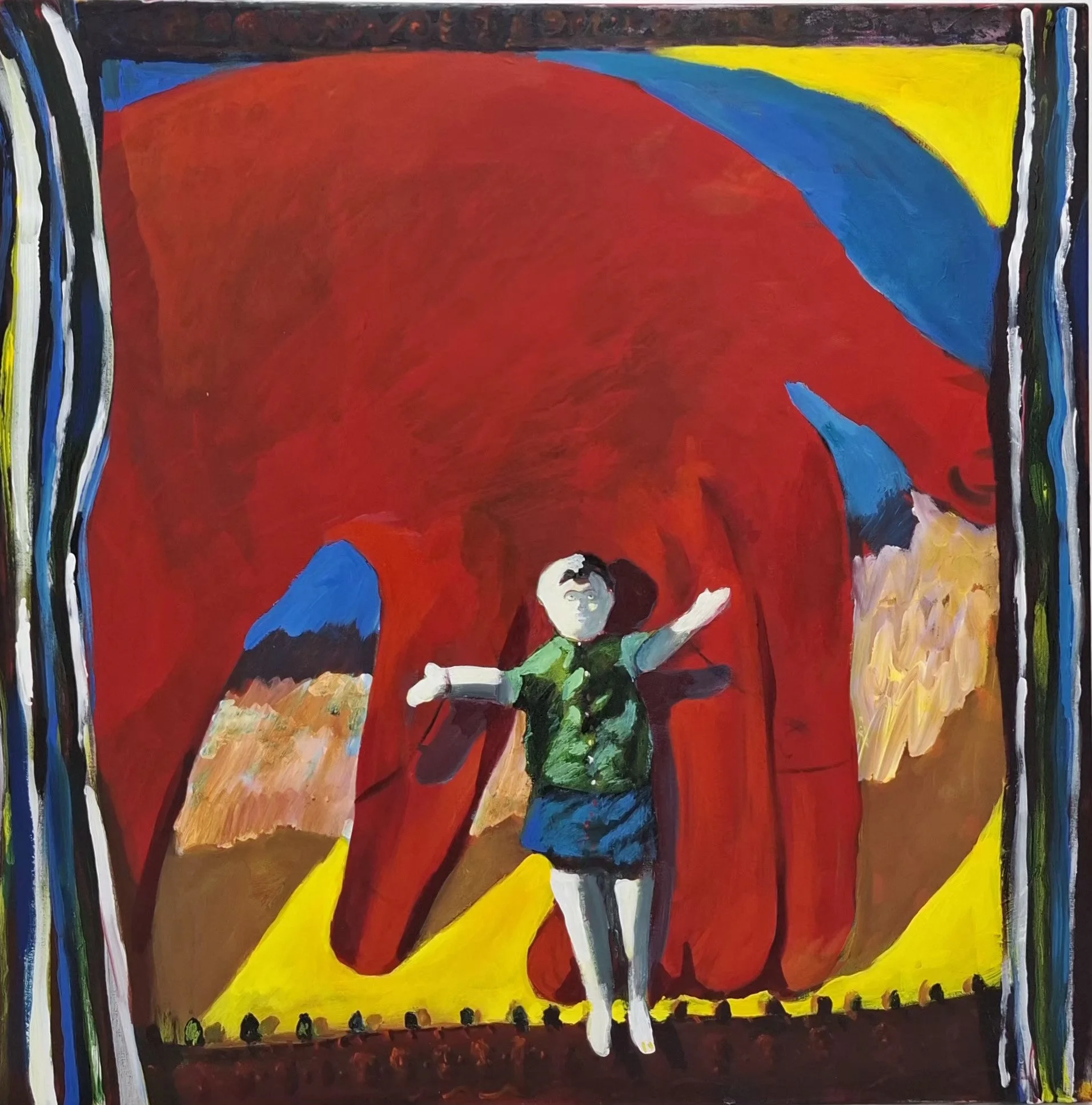
Hand Puppet, 2026
Acrylic on canvas
31.5” x 31.5” in
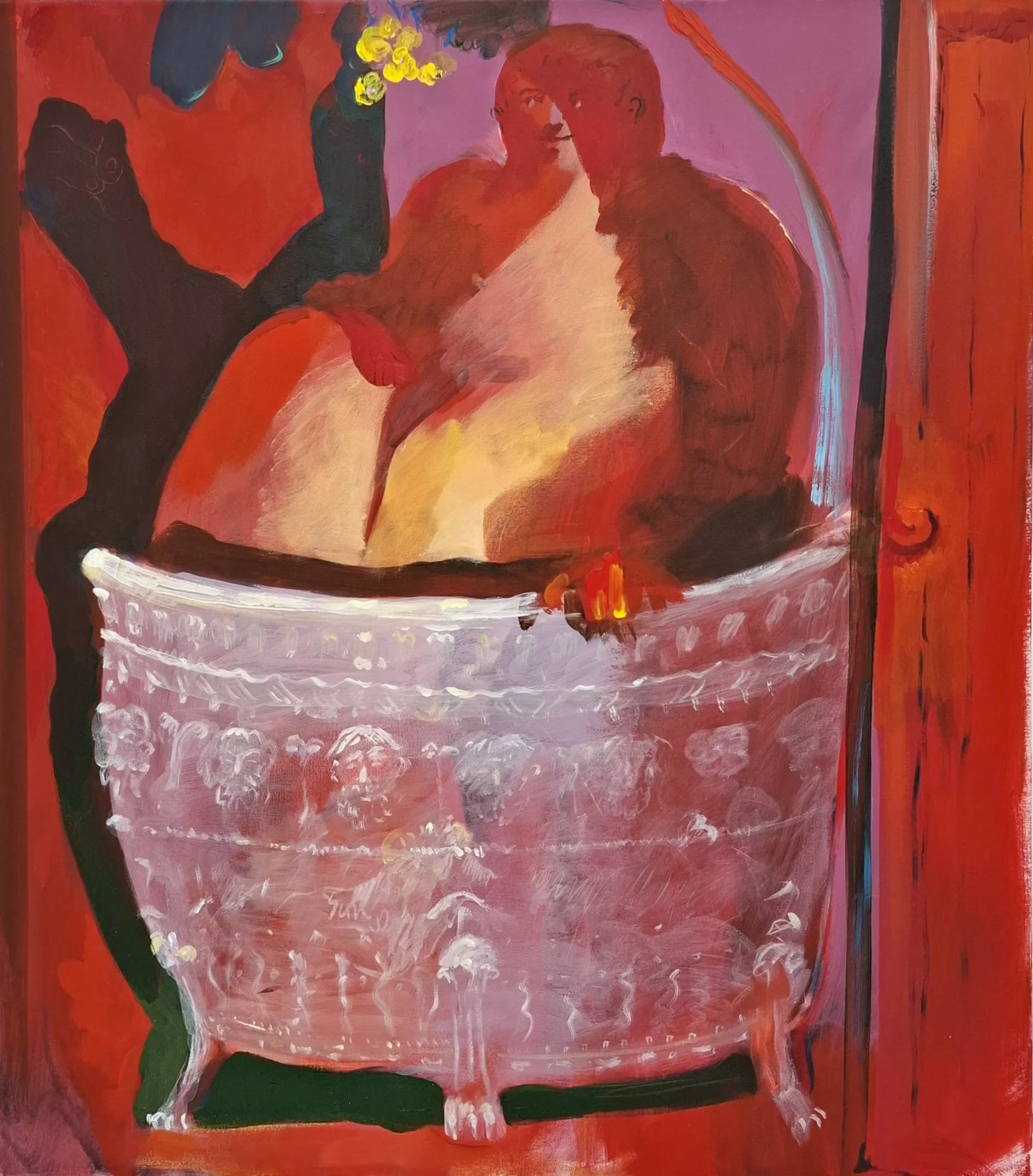
Flowers Cathecis, 2026
Acrylic on canvas
35.4” x 31.5” in